
Frontex, Europol widen data sharing under new border arrangement
Jul 31, 2026
Category: Border and Security EU Frontex News
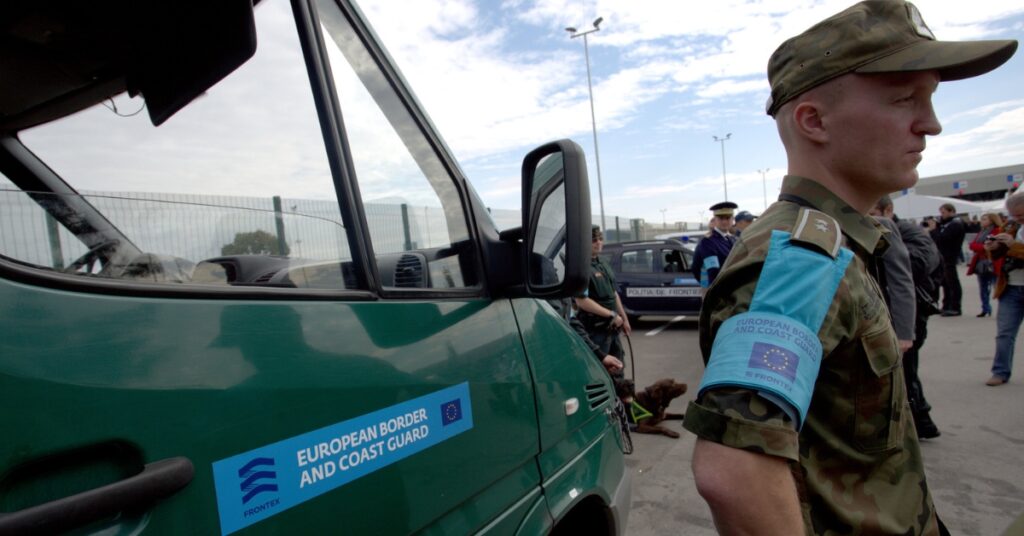
Frontex and Europol have signed a new working arrangement that expands the exchange of border information with law enforcement and updates their cooperation framework for the first time in more than a decade.
The arrangement covers information sharing, joint operations and support for national authorities at the European Union’s (EU) external borders and elsewhere in Europe. It took effect the day after it was signed.
Frontex executive director Hans Leijtens and acting Europol executive director Jürgen Ebner signed the document, replacing a 2015 cooperation agreement.
Both agencies have since received revised mandates, through the 2019 European Border and Coast Guard Regulation and changes to Europol’s mandate. EU data protection law has also evolved.
However, the arrangement is an administrative framework and creates no new legal rights or obligations under EU, national or international law.
Case by case
Personal data exchanges are subject to strict conditions.
They may include operational data on individuals suspected of cross-border crimes, such as migrant smuggling. Frontex will assess each Europol request against established criteria.
Transfers are permitted only when strictly necessary and proportionate to Europol’s tasks. Shared data may be used only for its stated purpose.
Any further use requires approval from the agency that supplied it and must remain compatible with the original purpose. The agencies will also report back on how the data is used.
The exchange rules will be reviewed at least annually and reflect recommendations from the European Data Protection Supervisor.
Ships and planes only
The agencies will also cooperate through EUROSUR, the European Border and Coast Guard framework for exchanging border-related information.
Frontex will prepare and share specific situational pictures with Europol under a dedicated cooperation plan. These may contain only limited personal data, such as ship and aircraft identification numbers.
The agencies will coordinate joint operations and EU-wide actions, including through EMPACT, the EU framework for tackling serious and organised crime.
They will also exchange experts and liaison officers, conduct joint training and cooperate on research and innovation.
Regular senior-level meetings and a joint cooperation plan will guide implementation, while both agencies have committed to continuously reviewing the arrangement.

Ink dries in Dublin
The arrangement was signed in Dublin on 16 July during a gathering of EU justice and home affairs ministers.
Frontex described the event as an informal ministerial meeting under Ireland’s Presidency of the Council of the European Union.
European Commissioner for Internal Affairs and Migration Magnus Brunner and Ireland’s Minister for Justice, Home Affairs and Migration, Jim O’Callaghan, witnessed the signing.
The European Commission approved the arrangement on 8 July 2026, as required under EU law. Frontex will notify the European Parliament and the Council, and the full text will be available on its website.
Watchdogs shadow every exchange
All activity under the arrangement must comply fully with fundamental rights and personal data protection rules.
The agencies’ fundamental rights officers will monitor implementation and support each other’s work. Their data protection officers will also cooperate to ensure consistent standards.
Frontex remains subject to EU law, including the Charter of Fundamental Rights, and has an independent fundamental rights officer. The European Data Protection Supervisor oversees its compliance with data protection rules.

“Frontex sees the border”
Leijtens described the arrangement as combining the agencies’ different perspectives.
“Frontex sees the border. Europol sees the criminal networks behind it,” he stated, adding that the arrangement brings the pieces of the same jigsaw together and builds on existing cooperation between officers and analysts.
Ebner stressed that criminal networks “do not distinguish between border security and law enforcement” and exploit available weaknesses. Information collected at the external borders, he noted, may provide the first sign of criminal or terrorist activity.
Brunner focused on organised crime’s finances, arguing that migrant smuggling generates major profits and that dismantling networks requires cutting off their income.
The agreement should allow authorities to exchange information more quickly, close operational gaps, and trace criminal proceeds, he added.
O’Callaghan described the revised arrangement as strengthening an established relationship and supporting member states against migrant smuggling, human trafficking and terrorism.
Ten arrests, one blueprint
The agencies highlighted a December 2025 operation as an example of the cooperation they hope to expand.
Weeks of Frontex maritime monitoring, conducted with Europol, supported a Greek-led investigation that ended with the interception of a drug-smuggling vessel in the Caribbean and ten arrests.
The agencies argued that the new arrangement provides a stronger basis for similar operations.
It also supports the implementation of EU migration and border rules under the Pact on Migration and Asylum, which took effect on 12 June 2026.
Both agencies described border management and organised crime enforcement as complementary, noting that transnational criminal groups move people and illicit goods across the EU’s external borders.

Fine print decides reach
The arrangement’s practical effect remains uncertain.
The joint cooperation plan and detailed exchange rules have yet to be agreed. Those documents will define how the framework operates in practice.
Until then, the arrangement remains largely procedural.
The annual review of exchange rules and reports from fundamental rights officers will be key indicators of whether the boundary between border registration and criminal intelligence begins to shift.