
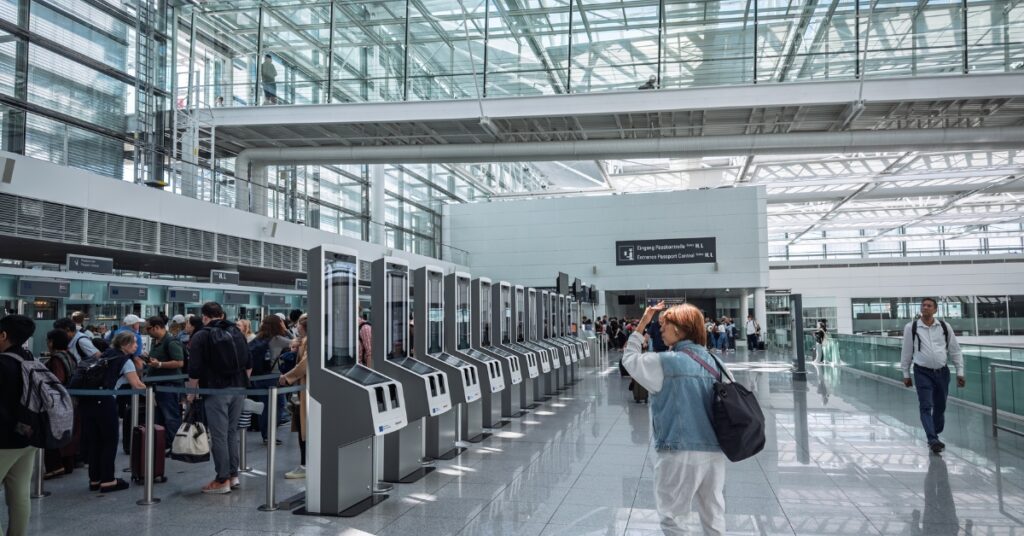
The European Union’s Entry/Exit System (EES) is snarling airports and ports across Europe, and EES delays are now driving loud calls to suspend the checks during peak season.
The system registers non-EU nationals each time they cross an external border, taking fingerprints and a facial image on first entry. It replaces the old passport stamp.
The EES launched on 12 October 2025 and became fully operational across 29 European countries on 10 April 2026. Cyprus and Ireland still stamp passports by hand.
Roughly 1,700 crossing points now require it. The first enrolment step, where fingerprints and facial images are captured, is the main bottleneck.
Delays to flights climbed sharply after April’s full rollout. Airports in Spain, Portugal, France and Italy have been among the worst hit.
Dover braces for gridlock
The Port of Dover has warned of “utter chaos” as summer traffic builds. MPs are pressing ministers to act before queues spill onto local roads.
Karen Bradley, who chairs the home affairs committee, urged the government to “apply maximum pressure” on French authorities before traffic peaked from Friday 17 July.
Checks at the start of the May half-term produced four and a half hours of delays. The port expects almost 50% more vehicles this summer.
Dover built a £40m biometric facility with 84 automatic kiosks for car travellers. It has been closed due to technology and software issues attributed to French suppliers.
“Without greater flexibility in how EES is operated during periods of exceptional demand, we will face repeated episodes of severe congestion throughout the summer holiday period,” warned the port’s chief executive, Doug Bannister.
His traffic modelling showed “queueing cars spilling out of the port on to the public highway for miles.” He cautioned that both Dover and Folkestone would be badly affected.
Westminster splits over pause
Home Office minister Alex Norris told MPs that the government would “push very heavily” for France to “prioritise flow.” He stopped short of backing a full suspension.
“I would not set that as the goal and the aspiration, because I don’t believe that’s deliverable,” Norris told the committee.
Shadow minister Matt Vickers went further. He attacked a “delusional attitude among EU colleagues” and repeated his call to halt the scheme for the peak season.

No pause, EU says
The EU has rejected calls for suspension. Officials said that only 20 of roughly 1,500 crossing points counted as “difficult spots.”
That decision came the day before the Dover warnings. Airports and airlines had asked for fingerprinting and facial checks to be paused.
Border police can still suspend checks temporarily to clear all travellers. That discretionary power runs out in September.
Four hours early, or madness
New guidance suggested that Britons may need to arrive four hours before flights. The time to clear passport control has reportedly tripled at some European airports.
The bigger risk is the journey home, when passengers face new exit checks before reaching the gate.
“Arriving four hours early is not a sensible blanket rule for every flight, but at some European airports this summer it is no longer a ridiculous precaution,” observed Anton Radchenko, founder of AirAdvisor.
Julia Lo Bue-Said, chief executive of the Advantage Travel Partnership, advised leaving three to four hours from the point of entry. Wizz Air’s Yvonne Moynihan told travellers to add an extra hour, and to pack water and a charger for arrival queues.
Not everyone agreed. Paul Charles of the PC Agency called four-hour check-ins “madness,” noting that desks are often not even open that early.
“Telling every traveller to arrive four hours early is probably an overcorrection,” argued Helena Sheizon, immigration director at Kadmos Immigration. She urged passengers to check their own airline and airport advice instead.
Left behind at gate
Missed flights have become a familiar story. Around 100 easyJet customers were stranded at Milan Linate on 12 April as three-hour queues formed.
The airline said that the situation was “outside of our control” and called the hold-ups “unacceptable.” The Manchester flight left half-empty after the crew neared their legal working limit.
Days later, a Ryanair service from Milan Bergamo departed on 16 April without several passengers. Reports suggested that around 30 were left behind.
Queues here to stay
Industry bodies expect the strain to last. The International Air Transport Association warned that queues could reach six hours and flagged missed connections in Portugal, Spain, Italy, Greece and Belgium.
Ryanair cautioned of “queue chaos” at Málaga, Alicante and Palma.
Frontex deputy executive director Uku Sarekanno told a Westminster travel conference in June that delays could run for one to two years. Repeat visitors within three years would get faster entry, he noted.

Twins see double trouble
A separate flaw is unsettling families. Twins Trust said that facial recognition software often misidentifies identical twins as the same person.
Campaigns head Victoria Morrell, mother of two sets of identical twin sons, described repeated problems at airports. In April, a British woman was questioned by Romanian border police after being wrongly scanned as her twin sister, who had travelled from Amsterdam.
A European Commission spokesman told Politico that biometric and passport data together allow each traveller to be identified separately.
Refusals, revocations and a million exemptions
eu-LISA’s first quarterly figures cover January to March 2026 and only sites where EES was running. They logged 19,985 refusals of entry, 11,885 extensions of stay and 665 revoked authorisations.
A further 978,940 travellers were exempt from fingerprinting, mainly children under 12. Ukrainian nationals topped refusals at 4,771, ahead of Albania and Moldova.
Clock ticking on fix
Full deployment is complete, and the power to suspend checks expires in September. MPs, airports and travel bodies want either a working system or a pause during peak demand.
Brussels insisted that the trouble is confined to a small handful of crossings. The coming weeks, at the summer’s busiest, will test that claim.
[…] had been pencilled in for late 2026. Persistent problems after EES went live, including software trouble at French entry points, have left it […]