
EU border queues push fifth of Britons towards staycations
Aug 18, 2026
Category: Border and Security EES EU News
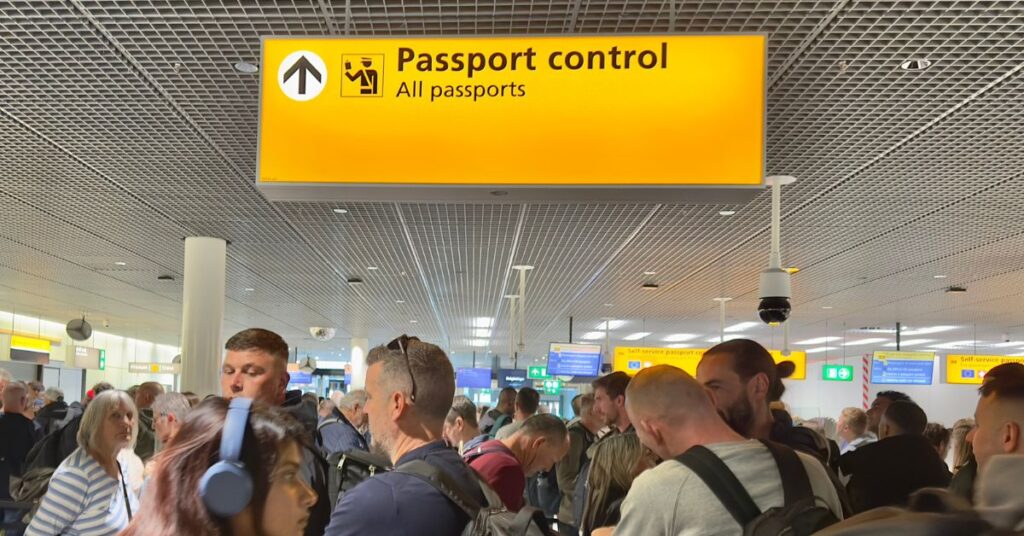
Nearly one-fifth of UK adults have considered swapping a European summer holiday for a British break as queues caused by the EU’s entry/exit system (EES) reach five hours at peak times, new polling suggests.
Savanta polling for The Independent found that 43% of UK adults have changed their travel plans, are considering doing so, or feel more anxious about travelling abroad.
Of 2,381 adults surveyed online between 17 and 21 July, 48 had cancelled a trip because of the border rule change.
Queue fatigue sets in
Some 17% would consider travelling at quieter times to avoid queues, while 16% feel more stressed or worried about EU travel. A further 15% are considering a UK holiday instead of a European trip.
The findings come amid growing calls to scrap the EES, less than four months after it became fully operational.
Five hours at the gate
Delays are evident at Europe’s busiest airports.
The chief aviation officer at Rome’s Fiumicino airport reported that the system has nearly tripled passport-control processing times.
Peak waits of up to five hours are forcing travellers to arrive unusually early to avoid missing flights or ferries. British holidaymakers and hauliers have faced hours-long queues, with some missing departures.
Airports Council International Europe, Airlines for Europe and IATA said that border-control waiting times have risen significantly since the full rollout in April.
They warned that millions of passengers entering the Schengen area are affected, including families with young children, elderly passengers and people with reduced mobility.

Airports run out of patience
The organisations have taken their concerns directly to European Commission president Ursula von der Leyen.
In a joint letter, they declared that the situation has “reached a critical point” and called for “immediate intervention before the situation deteriorates further.”
They argued that the current implementation of the EES “is creating severe operational consequences disrupting passengers and putting border authorities, airports and airlines under unsustainable pressure.”
They also cited flight delays, missed connections and increasing pressure on frontline staff.
Stefan Schulte, president of ACI Europe, told the association’s annual assembly in Prague that the current state of the EES is “what keeps me and many other airport CEOs across Europe awake at night.”
Schulte has urged the Commission to introduce a new aviation strategy restoring Europe’s “competitiveness.”
In June, the head of Europe’s aviation trade association urged EU ministers to “stop pretending” the biometric border system is “working just fine.”
Westminster left waiting
Political pressure in Britain has so far yielded little action.
Liberal Democrat Europe spokesperson Al Pinkerton wrote last month to then-Cabinet Office minister Nick Thomas-Symonds, since replaced by Hamish Falconer, urging the government to seek an emergency meeting with the Commission before the school holidays began on 20 July.
The government is understood not to have responded.
“Millions of British families and travellers are facing the threat of travel misery this summer before they have even reached the beach, all because of the severe queues caused by the EU’s dysfunctional entry/exit system,” Pinkerton told The Independent.
He called the polling “deeply concerning” and urged emergency measures with European partners “before peak summer travel turns into complete chaos.”

Cheques written at Dover
The government points to investment at key pressure points.
“While the new EES checks are a matter for the EU, we recognise this is a significant change for British travellers and are doing everything we can to get people away on their summer holidays with as little hassle as possible,” a government spokesperson stated.
Ministers have provided £10.5m for infrastructure improvements at the Port of Dover, Eurotunnel and Eurostar, with another £20m for increased passport-checking and vehicle-holding capacity at Dover.
Traffic measures also include welfare sites that offer food, water, and facilities during severe disruption.
The spokesperson credited French authorities for “their close collaboration and their recognition of the need for high levels of border staffing over the summer.”
ABTA breaks ranks
Not everyone in the travel industry shares the concern.
ABTA, the UK’s largest travel trade association, insists the system is “not proving a significant deterrent to travel in practice.”
“Currently, destinations do appear to be taking a pragmatic approach which is prioritising passenger flow and seeking to minimise disruption,” a spokesperson remarked.
ABTA says contingency measures, registration facilities and staffing are helping to limit disruption and wants the arrangements extended beyond September.
It has also proposed better signage and separate queues for passengers who have already registered and do not need to repeat the full process.

From stamps to scans
The EES registers non-EU nationals travelling for short stays whenever they cross the external borders of 29 European countries, replacing passport stamping across most of the continent.
Its phased launch began on 12 October 2025, and it became fully operational on 10 April 2026.
First-time travellers must provide fingerprints and facial scans and register their passport. The system records travel-document details, entry and exit dates and locations, biometric data and refused-entry information for stays of up to 90 days in any 180-day period.
Cyprus and Ireland continue to stamp passports manually. Exemptions include holders of residence permits and long-stay visas, certain relatives of EU nationals, and nationals of Andorra, Monaco and San Marino.
The Commission said that the system is intended to modernise checks, gradually reduce waiting times, strengthen border security and identify overstayers.
Member states may also operate National Facilitation Programmes for frequent non-EU travellers.
September on the horizon
The dispute now centres on what the border disruption means.
Airport operators and airlines see five-hour peak waits as evidence of systemic failure, while ABTA argues that contingency measures are limiting disruption.
Both sides agree on one issue: measures credited with easing queues are due to expire after September, and both want the Commission to extend them.
That will test the Commission’s claim that the EES can gradually reduce waiting times once fully operational.
Meanwhile, the polling measures intended behaviour rather than actual bookings, leaving it unclear whether the 43% figure will translate into lost revenue for European destinations.