
Heat, Gridlock Force France to Ease EES Checks at Dover
Jun 1, 2026
Category: Border and Security EES News UK
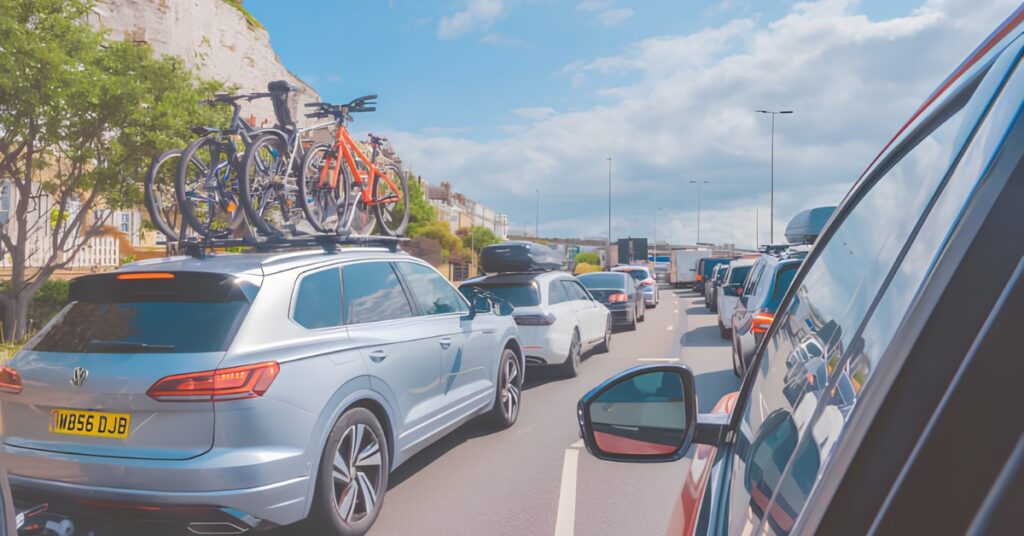
France pulled back its new European Union (EU) border checks at the Port of Dover after thousands of holidaymakers were stuck in queues lasting hours on the hottest day of the year.
The move targeted the EU’s Entry/Exit System (EES), the digital scheme now rolling out across Europe. French border police eased the extra checks as the May bank holiday getaway ground to a halt in temperatures above 30C.
French officers known as Police aux Frontières (PAF), who carry out French controls on the UK side of the Channel, invoked the Article 9 clause of the EES regulations. The clause allows checks to be relaxed in exceptional circumstances.
Conventional border checks stayed in place throughout. Only the additional EES requirements, chiefly the registration of non-EU travellers, were paused.
Extra measures were switched back on at around 5pm on May 23rd. The easing therefore covered part of the day rather than the full weekend.
Queues stretch for hours
The trigger was a brutal combination of long queues and high heat. Accounts of the worst delay vary by outlet.
The Telegraph cited waits of up to four hours. LBC placed the figure at three hours.
The Guardian and BBC described more than two hours just to reach the port, followed by up to a further two and a half hours to clear the terminal.
Tourist traffic in the buffer zone faced roughly two and a half hours of processing before the easing kicked in.
May 23rd was the hottest day of the year so far, with a reported high of 30.5C at Frittenden in Kent and amber heat health alerts across parts of England.
Traffic frees up fast
Once the EES requirements were lifted, processing times dropped quickly.
By lunchtime the port said that traffic was “slow moving” and check-in had fallen to under an hour. Just after 2pm, it described the flow as “free flowing”.
Processing for tourist traffic dropped to about 50 minutes after the biometric registration requirement was suspended.
By May 24th morning, the picture had improved again. The Port of Dover reported “free flowing” traffic with waits of around 35 minutes for tourists.
About 18,000 passengers were expected through the port between May 22nd and 23rd, with more than 8,000 on Saturday alone.
The port called it the “first peak period” since the new procedures became fully operational the previous month.

Technology not yet working
At the heart of the problem sits unfinished technology.
Doug Bannister, chief executive of the Port of Dover, told the BBC that the port had spent £40m on a new EES facility built on reclaimed land and fitted 84 kiosks. It could not open them.
“We put a monitoring system in place, and we are prevented from opening that because the technology is not yet functional,” Bannister explained.
Work designed for 84 positions in the western docks was being squeezed through just 11 border positions. “That is where the challenge comes,” he added.
Biometric capture, meaning fingerprints and photographs, was not actually happening. Technical faults with the pre-registration self-service kiosks meant French officers had been manually creating traveller records for motorists since full operation began on 10 April 2026.
Bannister said that PAF had supplied enough staff and “worked flat out”, but the manual process was slow. Officers reverted to a more manual approach to clear the backlog.
He did not hide his frustration. “Despite having assurances from authorities, from our government, from the French around how this would work it really was slow processing this morning,” he told the BBC. “I think we’re all quite frustrated.”
Travel industry sounds alarm
The disruption drew sharp words from the travel sector.
EasyJet chief executive Kenton Jarvis urged EU countries, and Spain in particular, to drop the new rules. The extra checks would “put off” holidaymakers, he warned.
Julia Lo Bue-Said of the Advantage Travel Partnership had already told British travellers to allow plenty of time. She advised allocating four hours to navigate the new system in its early stages.
Travel correspondent Simon Calder struck a calmer note. “Everything is now relatively speedy,” he told Sky News, adding that British citizens require heavy processing because they are checked before travelling to France.
Kent councillors backed proposals to shift some border work inland. One option would use the facility at Sevington, near Ashford, to hold or process Europe-bound traffic before vehicles reach the port.
Chaos spreads beyond Dover
The Dover queues were not the only headache of the weekend.
LeShuttle reported delays of about 1.5 hours on Channel Tunnel services between Folkestone and Calais, plus longer processing at the border.
Rail strike action by the Transport Salaried Staffs’ Association, combined with Network Rail engineering work, hit major routes. The East Coast Main Line closed between York and Darlington, buses replaced trains between Newport and Bristol Parkway, and no Thameslink services ran through central London, affecting Gatwick and Luton.
By around 3pm on May 23rd, Traffic England had issued 22 severe congestion alerts on motorways and major A-roads. Traffic Scotland and Traffic Wales reported further problems.
Digital checks replace passport stamps
The EES swaps manual passport stamps for a digital record of non-EU travellers entering and leaving the Schengen area. It is also meant to capture biometric data.
It applies across 29 participating Schengen countries, including Switzerland, Norway and Iceland. Ireland and Cyprus keep manual stamping.
The rules affect Britons because the UK left the EU in 2020 under Brexit. The European Commission says the system aims to make borders more secure, more efficient and stronger against irregular migration.
The port’s Traffic Access Protocol, introduced in 2015, stayed in force to limit knock-on congestion. Passengers who missed sailings were moved to the next crossing free of charge, and were asked to bring food and water and to treat staff with respect.

Summer test still looms
The weekend was the first real stress test of the EES under heavy traffic. The fix at Dover was temporary, not a scrapping of the system.
With the kiosks still offline and summer approaching, the pressure to get the technology working is mounting. For now, French officers will keep doing by hand what 84 machines were built to do.