
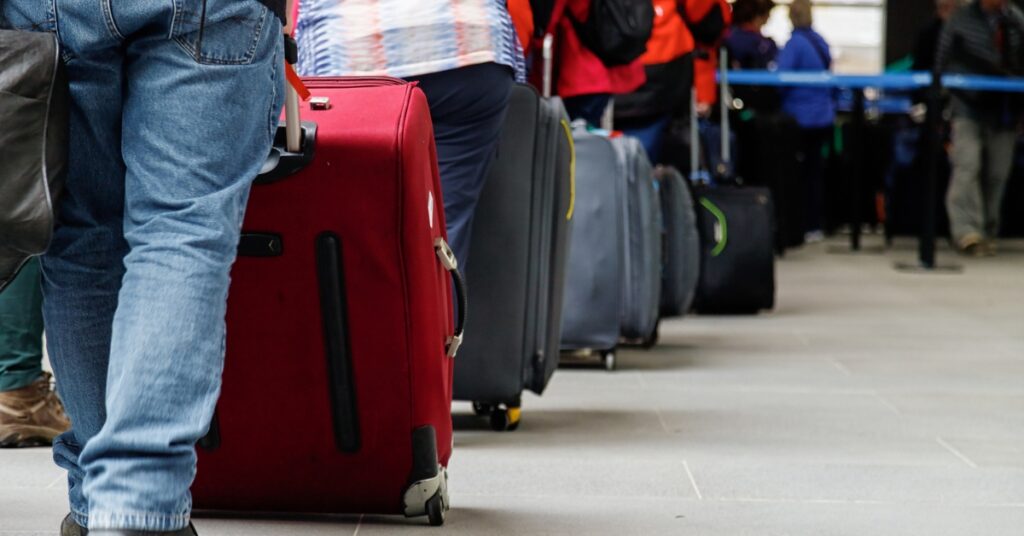
The European Union’s new Entry/Exit System (EES) caused widespread disruption across European airports on its first day of full operations, with passengers missing flights, spending thousands of pounds on alternative travel, and industry groups calling the rollout a “systemic failure.”
The biometric border control system went live across 29 Schengen-area countries on 10 April 2026, replacing manual passport stamping with digital records of entries, exits, and refusals of entry.
It requires all non-EU nationals, including Britons, to register facial scans and fingerprints when entering the Schengen zone for short stays. Peak-period queues of two to three hours were recorded at multiple airports on the first day alone.
Plane leaves 122 behind
The worst-documented incident took place at Milan’s Linate airport on 13 April, where an easyJet service to Manchester departed with only 34 of its 156 booked passengers on board, leaving 122 stranded in Italy.
Among those left behind was the Hume family from Leeds.
Max Hume, 56, a teacher, his wife Lynsey, 46, and their 13-year-old son Archie had arrived at the terminal nearly three hours before their scheduled departure. They had already queued for over an hour at passport control on their way into Italy the week before.
At the border that morning, officials demanded fingerprints and facial biometrics from every passenger, despite the data having been collected on arrival in Italy days earlier.
EES rules state that once both biometrics are registered, only one check is required on subsequent crossings. Only two officers and one biometric machine were in use, with approximately 16 machines left idle.
Hume described the experience as “gutted, upset, let down, absolutely shattered and poorer — much poorer.”
Carol Boon, 59, from Staffordshire, had been on a hen weekend with five friends. She described the scene at border control as “very stressful; people arguing, someone fainted, someone was sick.”
Joy Oliver from Lancaster called it “absolute carnage.” Adam Hoijard from Wirral, whose family also arrived three hours early, called it “atrocious” to be blamed for not turning up sooner. His five-year-old son was left “lying in bed crying” after the ordeal.
Passengers booked on other non-Schengen flights departing the same morning, including British Airways services to Heathrow and a separate easyJet flight to Gatwick, were reportedly waved through without issue.
Some Manchester-bound passengers are said to have told border staff they were flying to London in order to get through.
Thousands spent, little refunded
For families left in Milan, the cost of getting home proved steep.
The Humes eventually booked flights via Luxembourg, a hotel overnight, then an onward service to Manchester the next morning, spending over £1,600 in total. The BBC put the figure at over £1,800.
EasyJet offered the family a refund of £19.91, the tax portion of their original ticket, and the option to rebook five days later for an additional £300 to £330.
EasyJet’s live chat service told Hume that the airport process “is not our responsibility” and that the only assistance available was a “rescue transfer” at £110 per person. The family had initially been recorded at the easyJet desk as “no-shows.”
Trains from Milan were quoted at £500 each; one-way car hire at £5,000.
Hoijard spent £1,000 booking alternative flights to Gatwick. Boon paid for an apartment in Milan while she waited for a Tuesday flight to Gatwick.
EasyJet said in a statement that it had warned passengers to allow extra time, had held flights to give passengers additional boarding time, and had offered free transfers to those who missed their flight.
“While this is outside of our control, we are sorry for any inconvenience caused,” the airline’s spokesperson said.

Airlines demand full suspension
Airport and airline industry bodies ACI EUROPE and Airlines for Europe (A4E) issued a joint statement on the day of the launch calling on the European Commission and EU member states to introduce additional flexibility in how the system operates.
ACI EUROPE Director General Olivier Jankovec and A4E Managing Director Ourania Georgoutsakou said: “Strengthening border management must not come at the expense of operational efficiency or the passenger experience.”
On Monday 14 April, A4E went further in a separate statement. Three hours queuing at border control was not an EES “teething issue,” it wrote, but a “systemic failure.”
The group called on the European Commission to allow the full and partial suspension of EES until the end of summer where necessary.
Both organisations had cautioned about rollout challenges for weeks before the launch. Their statement noted that on 10 April alone, one flight departed missing 51 passengers.
On another occasion, no passengers had reached the departure gate by closing time, and only 12 had arrived 90 minutes later.
Until 10 April, border authorities had the option to suspend EES operations entirely when queues became excessive. That option was removed on the day of full launch; only a partial suspension, which skips biometric capture, is now permitted.
The European Commission stated that registering a traveller takes an average of 70 seconds when the system runs at full capacity, a figure at odds with the hours-long queues reported across multiple airports.
Who bears blame?
Laura Featonby, who runs a travel agency in Sale, Greater Manchester, noted that the disruption in Milan may have been compounded by the fact that passengers who arrived before 10 April had not yet had their entry biometrics recorded, making the exit process harder for border officials to process.
She noted that while some airlines had delayed flights to allow more time for boarding, that depended on “operational reasons with airline slots, crews going out-of-hours etc.” She added that the airport border process was ultimately “not down to the airline.”
Hume was less measured in his assessment. “I really feel this shouldn’t be an insurance job,” he said. “The airline should take responsibility. There’s now 100 of us who won’t ever use easyJet again.”

Summer disruption looms
With peak travel season approaching, ACI EUROPE and A4E have warned that without greater flexibility, disruptions of this scale will recur throughout the summer months.
The situation at Linate on 13 April alone, where 78% of passengers on a single flight were left behind, offers a concrete picture of what airports across Europe could face if border authorities are not given the tools to manage queues more effectively.
Both bodies said that the Commission must act before the situation worsens.