
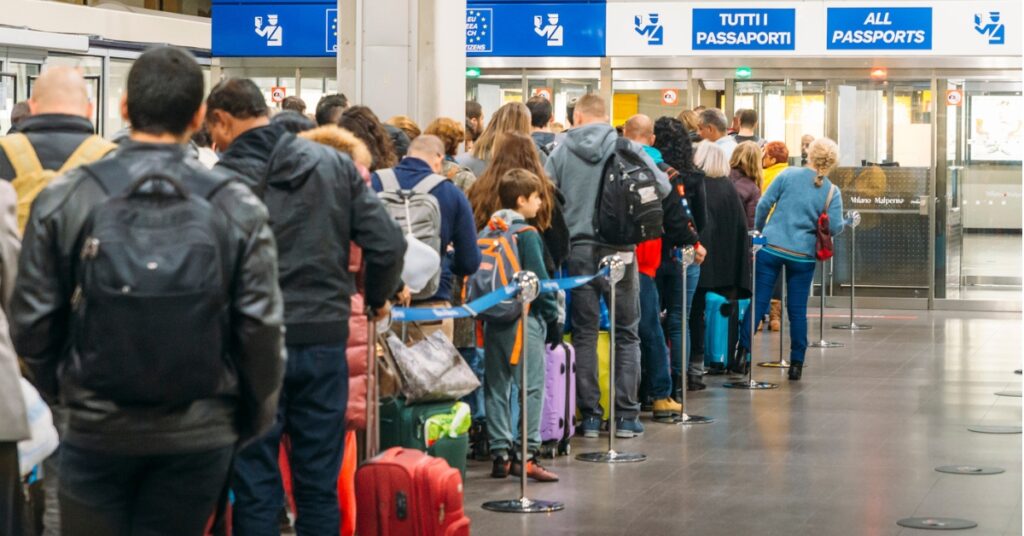
The European Commission has rejected demands from airlines and airports to suspend the European Union’s new biometric border checks, while admitting that 20 border crossing points are struggling with queue chaos.
EU officials told travel industry representatives that a full suspension of the Entry/Exit System (EES) was “not needed” and “not possible,” while acknowledging the system was “not perfect.”
The decision came a week before the summer holiday peak and hours before Commission officials met airline and airport leaders in Brussels. In the aviation sector, delays in the EES have already pushed border wait times to five hours at some airports.
EES requires non-EU nationals to register their fingerprints and facial images upon first entering the Schengen zone. Their biometrics are then verified whenever they leave and re-enter.
Commission digs in
A senior EU official said that a partial pause would not work. “The system doesn’t work if you have a full suspension [at] one of the other entry or exit points,” the official told Euractiv, because border authorities must continually reconcile entries and exits.
Officials warned that running EES in some countries but not others would strand travellers. Someone entering the Schengen area where controls were active but leaving through a border without them could be recorded as an overstayer and refused entry on a future trip.
Officials also noted that national capitals have remained silent. No member state has requested a suspension beyond September or changes to the current system.
Five hours at the gate
Europe’s airports and airlines said that conditions are far worse than Brussels admits. Since the full rollout in April, border control waits have reached five hours during peak periods, according to an open letter from ACI Europe, Airlines for Europe (A4E) and the International Air Transport Association (IATA).
The letter described families with young children, elderly passengers, and people with reduced mobility who were trapped in queues. It also reported flight delays, missed connections and growing pressure on frontline staff.
Passengers have queued outside terminals and on exposed aprons, while airlines have departed with half-empty aircraft because passengers remained stuck at border control, the signatories said.
The problem is not limited to major hubs. Smaller airports serving tourist destinations are equally affected, the letter said.
IATA reported delays and missed connections in Portugal, Spain, Italy, Greece and Belgium. Ryanair warned of “queue chaos” at airports including Alicante, Málaga and Palma.
European airports expect around 40 million more passengers in July and August than in the previous two months.

The ask that Brussels turned down
The letter to Commission President Ursula von der Leyen made two requests. First, it called for immediate flexibility, allowing member states to completely suspend EES, preventively, whenever passenger volumes exceed border capacity, at least through July and August.
Second, it sought a permanent operational flexibility mechanism by September, allowing border authorities to pause EES procedures in defined exceptional circumstances.
The letter was signed by Ourania Georgoutsakou of A4E, Olivier Jankovec of ACI Europe and Thomas Reynaert of IATA. They said that the proposal would not remove border checks, only restore standard Schengen Borders Code procedures, including passport stamping, when justified.
The signatories added that they fully support EES, arguing that security and efficient border management are complementary rather than competing goals.
Counting crossings, not queues
The Commission argued that the problems are limited. Of 1,500 border crossing points, only 20 are “difficult spots”, officials said, adding that pressure would be applied to the member states responsible.
One of the worst-affected sites was a small regional airport where 3,000 passengers arrived within an hour, but only four biometric booths were available. Officials said that, as a holiday destination, the problem lasted only two or three months a year.
Lisbon has eased queues by deploying extra staff, while 50 Frontex officers were assigned to Brussels Airport.
“I think we have recurrent progressive improvements everywhere,” one EU official said.
The Commission said that EES has recorded about 110 million journeys and refused entry to around 44,500 people.
The largest refusal category was the lack of an appropriate justification for the purpose of the stay. Around 9,000 refusals involved people who had exceeded the 90-day limit.
More than 1,000 travellers were refused entry on the grounds of threats to internal security, while around 300 were caught using false or forged documents.
Officials said that the figures show the system working as intended. Dual nationals who once bypassed the 90-day limit by switching passports can now be identified through fingerprinting and facial recognition.

Kiosks, tablets and an app that isn’t ready
Both sides agree that the technology remains incomplete. A Frontex-developed mobile app that allows passengers to upload data before departure is fully operational only in Sweden and is partially available in Portugal.
Technology problems in France have been blamed for delays at Eurotunnel, despite its £80 million infrastructure investment. French border officials were due to use tablets to verify fingerprints and facial images, but the system has not launched.
Confusion at kiosks is adding to the queues. Most passengers create a digital profile on their first visit, which is valid for three years, and then simply register their presence on later trips without providing biometrics again.
That distinction has not been clearly communicated at some airports, leading to longer waits at border control.
Tourism counts the cost
The World Travel and Tourism Council (WTTC) backed the aviation industry’s letter in a statement on 1 July. It warned that operational bottlenecks risk damaging both the visitor experience and Europe’s competitiveness as a destination.
Research based on more than 2,500 travellers in long-haul and short-haul markets found that about one in three would be less likely to visit the Schengen area if border waits of three hours or more became routine.
WTTC estimated that, based on 2026 forecasts, up to 41 million arrivals and $45.4 billion in visitor spending are at risk.
“EES represents an important step towards smarter, more secure borders for Europe,” Gloria Guevara, WTTC president and chief executive, stated. “But implementation must be practical, coordinated and traveller focused. … If lengthy delays become accepted practice, travellers will look elsewhere.”
The council called for faster adoption of the Travel to Europe pre-registration app, a coordinated communication campaign in key source markets, and full operational readiness at borders.
According to WTTC, travel and tourism contributed $3 trillion to the European economy and supported 40.7 million jobs in 2025.

September looms
The controls were eight years in development to address weaknesses exposed by the 2015 and 2016 terror attacks in Brussels and Paris. Their launch was repeatedly delayed.
Current rules allow airports and ports to pause the system in renewable six-hour periods when queues become unmanageable. That exemption expires in September.
The industry argued that member states are already relying heavily on the measure, but it has neither eased excessive queues nor protected airline operations. Brussels maintained that it is sufficient.
A Commission spokesperson promised to keep “working hard” with national authorities to resolve the IT issues delaying automation and the pre-registration app. Airports were also reminded that funding is available to deploy additional Frontex staff at high-pressure border crossings.
The EU is also reported to be delaying the European Travel Information and Authorisation System (ETIAS), a separate pre-authorisation scheme comparable to the US ESTA.