
A major new poll shows Europeans overwhelmingly oppose increasing immigration, with about half supporting large-scale deportations.
The YouGov survey across seven countries also reveals a widespread public misperception that most migrants are in Europe illegally.
Public backs deportations, borders
A YouGov poll conducted in Britain, Denmark, France, Germany, Italy, Poland, and Spain in November 2025 found consistent opposition to higher immigration levels.
Between 64% and 82% of respondents across these nations opposed a large increase in new migrants. Support for maintaining current immigration levels was low, exceeding opposition only in Poland and Denmark.
The most popular scenario was a “large decrease” in new arrivals, with some migration still allowed. This was backed by majorities or near-majorities ranging from 49% in Poland to 60% in Germany.
A more drastic policy also garnered significant support: approximately half of those surveyed, between 45% and 53%, said they would support admitting no more new migrants and requiring large numbers of recent arrivals to leave.
A widespread misperception
These views appear linked to a public misconception.
Pluralities or majorities in every Western European country polled believed more migrants were staying in their country illegally than legally. This ranged from 44% of Germans to 60% of Italians who held this view.
In Poland, the public was more divided, with 36% believing there were more illegal migrants, compared to 28% who believed the opposite.
The survey analysis states that these perceptions look “wide of the mark.” Official estimates of undocumented migrants are substantially lower than the foreign-born population in each country.
The report cites France as an example, where government estimates put the number of illegal migrants at around 700,000, far below the over nine million foreign-born people legally resident there.

Not all migrants
The desire for deportations is not a blanket rejection of all foreigners. When supporters of mass removal were asked which groups they had in mind, they overwhelmingly focused on those perceived as breaking rules.
Between 78% and 91% cited people who came to claim benefits. Between 73% and 85% named those entering through irregular means to seek asylum.
Between 66% and 85% pointed to workers without valid visas in unskilled jobs.
In contrast, appetite for removing other groups was limited. Only 15% to 24% of deportation supporters wanted to see doctors with work visas removed.
Similar low levels of support were found for deporting foreign students, skilled tradespeople, or asylum seekers who followed the correct legal process.
The report notes, “This is the equivalent of approximately 8-12% of the broader public in each country, which we could consider to be a rough ceiling for the most hardcore anti-migrant sentiment levels.”
Economic trade-offs matter
The survey also presented respondents with trade-offs, asking if they would still support reducing legal migration if it meant negative consequences. In almost every scenario, Europeans preferred the alternative benefit over cutting immigration.
The most convincing argument against reduction was staffing national health systems. This was the only trade-off that those who supported mass deportations consistently prioritized over reducing immigration.
Other strong arguments included getting enough workers to fill skills shortages and attracting “the best and brightest” talent. Increasing the number of people paying tax was consistently the weakest reason to keep migration levels up.

A deeper divide on integration, values
Attitudes extend beyond economics and legality into questions of culture and integration. While majorities (56-75%) said that illegal migration had been mostly bad for their country, views on legal migration were more split.
The Spanish were the most positive, with 42% seeing legal migration as mostly good. The French and Germans were the most negative, with 38% and 39% respectively saying that it had been mostly bad.
A majority in France, Italy, and Germany (53-57%) said that they felt legal migrants do not share the same values as them. Similar proportions in those countries said legal migrants are not integrating successfully.
The report states, “The concerns that many people have extend beyond the economic terms by which greater immigration is typically justified – anyone seeking to address the issue will need to engage with deeper anxieties about identity, integration, and the perceived erosion of shared national values.”
Building political pressure in Brussels
This public sentiment is translating into political pressure at the European level. As the poll was released, a group of 19 EU countries sent a joint letter to the European Commission urging faster action on migration control.
The coalition, which includes Austria, Italy, Sweden, and Germany, wants Brussels to provide sustained funding for “innovative solutions” like processing asylum seekers or returning them from facilities outside the EU, often called “return hubs.”
The ministers argued that without clearer funding pathways, these policies will remain theoretical. They also called for a stronger role for the EU’s border agency, Frontex, including a potential expansion of its mandate.
The push builds on a deal reached earlier in December on a new EU asylum and returns package.

New digital, physical borders
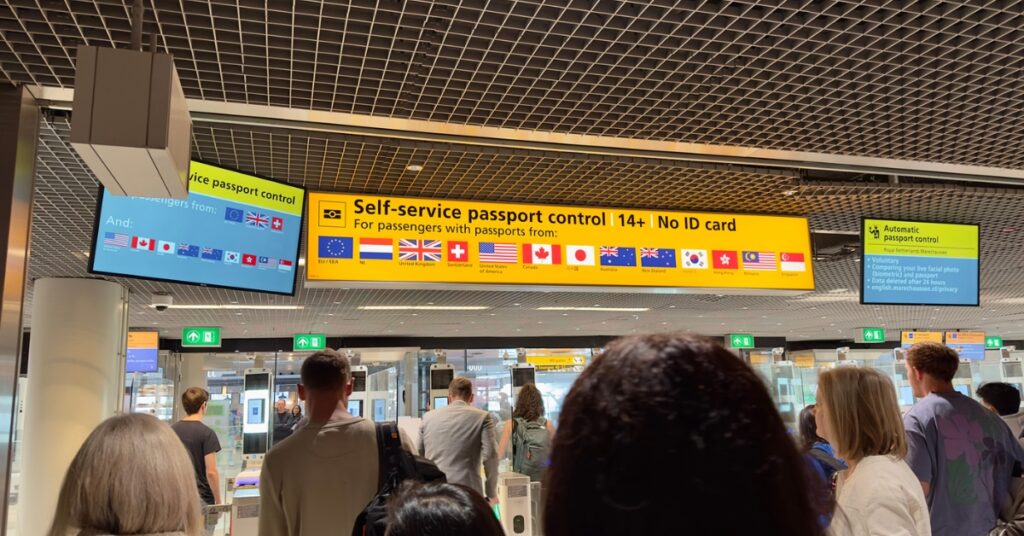
The political drive for stricter control is materializing in new layers of border security that will directly affect anyone coming to Europe.
Two major automated systems are being rolled out: the Entry/Exit System (EES) and the European Travel Information and Authorisation System (ETIAS).
For short-term visitors from non-EU countries, including visa-exempt nationals, travel is becoming more digital and tracked.
The EES, which began a phased launch in October 2025, replaces passport stamps with an automated register. It records traveler data each time they cross an external EU border.
The European Commission states that the system aims to “prevent irregular migration” by helping to stop people from overstaying.
Following the EES, ETIAS is set to go live in late 2026. This is a required online travel authorisation for visa-exempt visitors, costing €20.
The EU states that most applications will be processed within minutes, but it adds a new pre-screening hurdle. Having an ETIAS does not guarantee entry.
For long-term visitors or migrants, the landscape is shifting toward stricter external processing. The “return hubs” championed by EU ministers aim to handle asylum claims and returns outside the bloc’s territory.
For legal migrant workers, especially in skilled sectors like healthcare, the public’s economic pragmatism revealed in the poll may keep doors open. But the overwhelming focus on deporting “rule-breakers” signals increased scrutiny on compliance with visa conditions.
The bottom line
The research clearly shows a European public that strongly favours reducing immigration, and one whose views are shaped by a significant misperception about how many migrants are in their country legally.
As EU governments push for more external migration controls, the survey suggests that leaders will need to address these deep-seated public concerns about identity and integration, not just the numbers.