
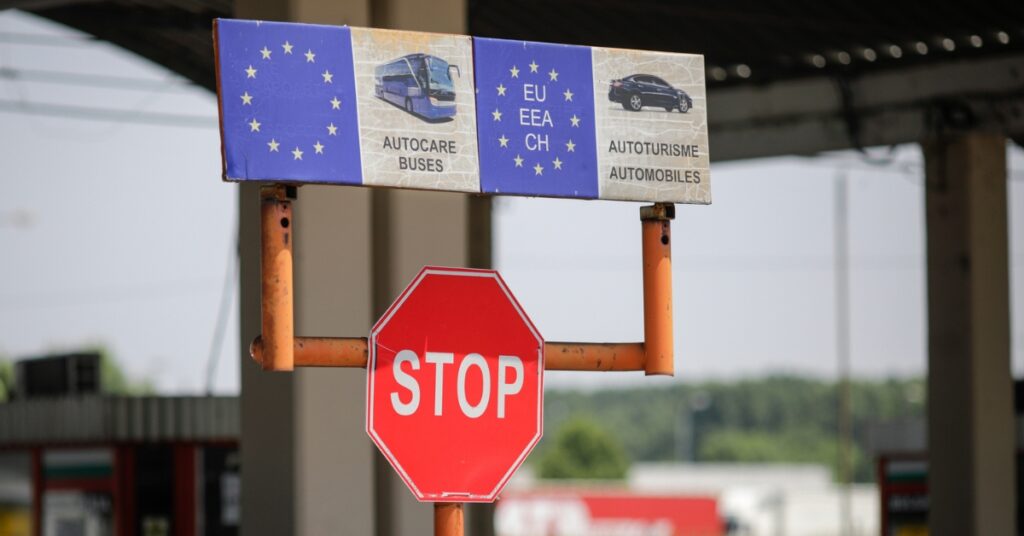
Irregular migration into the European Union dropped sharply in 2025, but EU migration policy is still heading toward tighter borders and stricter asylum rules.
EU leaders and member states are backing tougher controls, a bigger Frontex force, and faster deportations as the bloc reshapes how migration is handled this year.
Border numbers fall
Irregular crossings into the EU fell by about a quarter in the first 11 months of 2025, according to preliminary data from the EU border agency Frontex.
Just over 166,000 detections were recorded at the EU’s external borders, compared with the same period last year.
The largest drops were reported on the Western African route, where detections fell by roughly 60%, and the Western Balkan route, which saw a decline of more than 40%.
Frontex data shows that these routes had previously accounted for a significant share of irregular arrivals.
The Central Mediterranean remained the busiest route into the EU, accounting for nearly 40% of all detections. Most departures on this route continued to originate from Libya.
By contrast, the Western Mediterranean route saw an increase in crossings, rising by around 15% over the same period.
Policy moves ahead
Despite the decline in arrivals, EU migration policy continues to move toward stricter border control and enforcement.
Member states have backed faster asylum procedures, expanded border operations, and tougher return rules as part of the EU’s migration and asylum framework.
EU institutions have argued that tighter controls are needed to ensure consistent enforcement across the bloc.
Recent legislative agreements focus on speeding up decision-making at borders and reducing the number of people staying in the EU without legal status.
Migration remains a high-profile political issue across Europe, and policy decisions have continued even as arrival numbers fall.

Asylum rules change
A key part of the EU’s approach involves changes to asylum processing. Lawmakers have backed the first EU-wide list of safe countries of origin, which includes Bangladesh, Egypt, India, Morocco, and Tunisia.
Under existing EU rules, applications from nationals of countries on the list are expected to be processed more quickly through accelerated procedures.
The aim is to reduce backlogs and shorten the time spent waiting for decisions, particularly at border facilities.
Member states retain the ability to designate additional safe countries at the national level, provided that they follow EU criteria.
Returns take priority
Returns have become a central element of EU migration policy. New rules agreed by EU governments are designed to make it easier to remove people whose asylum claims are rejected or who do not have the right to remain in the bloc.
The return regulation allows for longer detention periods in specific cases and introduces penalties for non-compliance with removal orders.
It also promotes cooperation between EU countries so that return decisions can be enforced more consistently.
EU officials said that these measures are intended to improve the effectiveness of the asylum system by ensuring decisions are carried out.

Ukraine still central
While irregular migration has declined, displacement linked to the war in Ukraine continues to shape migration patterns in the EU.
As of October 2025, around 4.3 million Ukrainians were registered under the EU’s temporary protection scheme, according to Eurostat.
Germany, Poland, and Czechia host the largest numbers of people under the scheme. Although the total fell slightly compared with the previous month, it remains close to peak levels recorded since 2022.
The EU has extended temporary protection for Ukrainians until March 2027. This system operates separately from the asylum process and applies in cases of large-scale displacement.
Frontex expands role
Frontex continues to support national authorities at the EU’s external borders, with more than 3,500 officers deployed across Europe. The agency assists with border checks, returns, and cooperation with non-EU countries.
Plans discussed at the EU level would expand Frontex’s staff numbers and responsibilities, including a larger role in coordinating returns. Proposals also include wider use of digital tools and surveillance at borders.
Frontex operates under EU law and is subject to oversight by EU institutions.

What about travellers?
For short-term visitors, long-term residents, and migrants, the shift toward stricter border control is likely to be most visible during travel. Even as irregular migration declines, border checks are becoming more detailed and more reliant on digital systems.
The EU began rolling out the Entry-Exit System, or EES, in October 2025. The system gradually replaces passport stamps with electronic records for non-EU nationals entering and leaving the Schengen area for short stays of up to 90 days within a 180-day period.
Under EES, entry and exit dates are recorded alongside biometric data, including fingerprints and facial images.
The system is designed to identify overstays and misuse of short-stay rules more efficiently, which may lead to longer or more frequent checks at external borders during the rollout phase.
The changes also affect students, workers, and other long-term visitors who rely on short-stay limits when travelling in and out of the EU.
Further changes are expected with the launch of the European Travel Information and Authorisation System, or ETIAS, planned for late 2026. Under ETIAS, most visa-free travellers will need to obtain an online travel authorisation before entering 30 European countries.
ETIAS will be linked to a traveller’s passport and checked before departure. While it does not guarantee entry, it adds a pre-travel screening step that did not previously exist for many visitors.
Together, EES, ETIAS, and tighter migration rules point to a more controlled and monitored border system. For tourists, travel to Europe will require more preparation. For migrants, stricter enforcement remains the dominant direction.
Borders get tighter
Migration into the EU has fallen, but EU migration policy is moving toward stricter borders, faster asylum decisions, and stronger enforcement.
The gap between lower arrival numbers and tougher rules shows how Europe is prioritising control and deterrence over easing restrictions.
As new measures roll out, the focus will stay on how these policies change who can enter the EU and under what conditions.