
EU Entry-Exit System Triggers Three-Hour Airport Delays
Dec 31, 2025
Category: Border and Security EES EU News
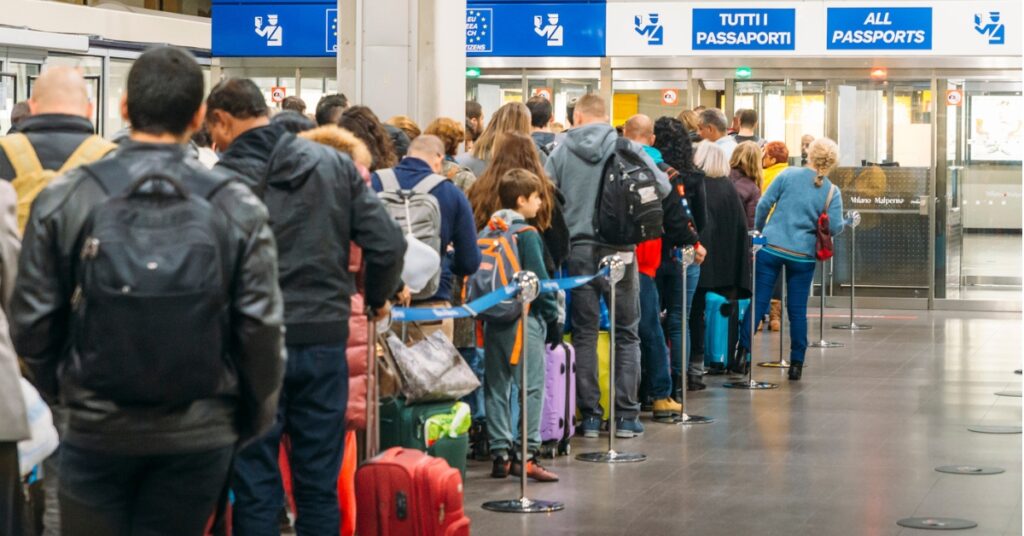
The EU Entry-Exit System has begun rolling out at airports across the Schengen area, causing waits of up to three hours at passport control for non-EU travellers.
Airports groups said that the new biometric border checks, introduced in October 2025, are slowing processing times and disrupting travel in countries including France, Spain and Germany.
Airports face growing queues
The EES is being introduced in stages at airports across the Schengen area, with early use already resulting in long queues for travellers arriving from outside the European Union.
The system replaces passport stamping with digital records and applies to non-EU nationals entering the bloc for short stays.
Airports Council International (ACI) Europe stated that the new checks have increased border processing times at some airports by approximately 70%. It said that passengers have experienced waits of up to three hours during busy travel periods, particularly at large international hubs.
Delays have been reported at airports in France, Spain, Germany, Italy, Portugal, Greece and Iceland. These countries handle high volumes of international travellers, especially during peak holiday seasons.
How new checks work
EES records the entry and exit of non-EU travellers visiting the Schengen area. It applies to people from visa-free countries such as the UK, the US and Canada who are allowed to stay for up to 90 days within a 180-day period.
Under the system, travellers must register biometric data the first time they cross an external Schengen border. This includes fingerprint scans and a facial image, which are stored digitally and checked on future visits.
The European Commission has said that the system is designed to strengthen border controls and make it easier to identify overstayers. It also aims to improve the accuracy of entry and exit records across member states.

Why lines are so slow
Airport groups say that the additional biometric steps have slowed border checks, particularly while the system is still new. Many travellers are unfamiliar with the process and need assistance when using registration kiosks.
ACI Europe said that some airports have experienced technical issues, including system outages and problems with self-service machines. It also said that the absence of a fully operational pre-registration app has added to delays.
Staffing levels are another issue. Border checks require trained officers to supervise biometric registration and respond to technical problems.
ACI Europe said that staff shortages at some airports are making it harder to manage passenger flow.
Airports raise red flags
ACI Europe has warned that increasing the number of travellers required to use the system could worsen delays if current problems are not resolved. Olivier Jankovec, director general of ACI Europe, said that passengers and airport operations are already being affected.
“Significant discomfort is already being inflicted upon travellers, and airport operations are being impacted,” he said.
He also warned that raising the registration threshold without fixes could lead to heavier congestion and safety concerns inside terminals. ACI Europe has called for greater flexibility in how the system is rolled out.
During the first phase, around 10% of eligible travellers are required to register under EES. This figure is due to rise to 35% from January 2026, with full implementation planned by April 2026.

EU pushes back on claims
The European Commission said that the EES has been launched gradually to allow airports and border authorities time to adapt. A Commission spokesperson said that the system has operated largely without major issues since its launch in October 2025.
The Commission said that some member states have already exceeded the initial registration targets, with more than half of the expected arrivals registered at certain borders. It added that processing times are improving as staff gain experience with the system.
Officials also said that countries can partially or fully suspend the system during exceptional circumstances, such as peak holiday periods, to manage long queues. The Commission said it is monitoring the rollout closely at both the EU and national levels.
What passengers are facing
For travellers, the changes mean longer waits at passport control, especially when arriving during busy times. Airports and travel experts have advised passengers to allow extra time to clear border checks.
Some travellers have reported missing onward transport due to delays at border control. Airlines have also raised concerns about knock-on effects, as late arrivals can disrupt flight schedules and airport operations.
Airports said that signage and staff support are improving, but queues remain likely while the system continues to expand. Travellers using the system for the first time are often slowed by unfamiliar steps and technical issues.

Who gets checked now
British travellers are among those affected by the new system following the UK’s exit from the EU. UK passport holders are now treated as non-EU nationals when entering the Schengen area.
The ees applies to short-term visits for tourism, business or family reasons. It does not replace visa requirements for travellers who already need a visa to enter the EU.
The rollout of EES comes ahead of the planned launch of the European Travel Information and Authorisation System, known as ETIAS. ETIAS will require visa-free travellers to apply online before travelling to most EU countries.
What comes next
The EU plans to continue expanding the EES in stages until it becomes mandatory for all eligible travellers. Further adjustments are expected as airports refine procedures and address technical issues.
The European Commission has not announced changes to the rollout schedule but said that it will continue working with member states and airport authorities.
Travellers are being advised to follow airport guidance and prepare for longer waits when entering the Schengen area during the rollout period.